The Browser is called BrassMonkey and is a fork of legendary Wicknix’sSeaLion from Linux. The version we are talking about is from Nov 2025 but
was only available for Intel Mac 10.6 and got now his way to 10.5 PPC.
It is also based on the modern UXP Engine like Powerfox
(Link)
is, and has a new updated code for even better compatibility with logging into
websites. It also doesn’t have a JIT Compiler, so script heavy sites will be
very slow. But it is written that people on the MacRumours Forums are currently
in the process of porting a JIT to Powerfox. Maybe it will also be available
for BrassMonkey.
T2/Linux has released version 26.3 “Desktop Edition,” marking a significant
milestone in delivering a modern, cross-architecture desktop experience.
The distribution distinguishes itself by providing a fully reproducible KDE
Plasma Wayland session across nine different CPU architectures, including x86,
ARM64, PowerPC, and RISC-V. This achievement is built on T2’s long-standing
foundation as a system development environment engineered for strict
cross-compilation, architectural correctness, and deterministic builds.
Anyone who reads my blog from time to time is familiar with my PowerMac setup.
I have two SSDs connected to the internal SATA ports: a 512 GB SATA SSD for
Mac OS X 10.5 and a 128 GB SSD for Linux. I also have an NVMe SSD
connected to the internal PCI Express x4 port.
The 128 GB SSD for Linux runs Debian 12 SID, and its primary function is to
boot the actual Linux distribution from the NVMe SSD. The PowerMac,
specifically the Open Firmware, doesn’t have drivers for NVMe, and neither
does Mac OS X. Therefore, it boots Grub from the internal SSD to load the
correct kernel and partition from the NVMe SSD.
After nine long months of laziness and overindulgence, I finally sat down
again to work on my beautiful terminal client for Navidrome, TerminalDrome,
and implemented a few bug fixes. I also made sure it continues to run
everywhere and improved the code quality a bit.
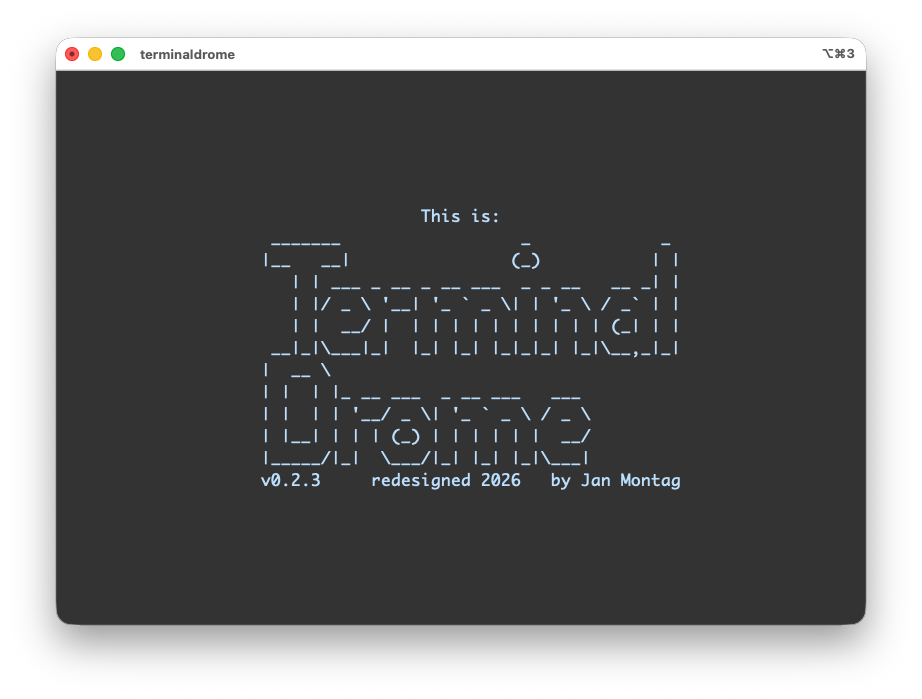
I am proud to announce TerminalDrome 0.2.3 for your pleasure.
What has changed in Version 0.2.3?
0.2.3 – Stability & Cross-Architecture Improvements, not visibile.
Fixed
Fixed duplicate selection decrement in navigation logic (on_up)
Fixed potential division-by-zero in progress bar calculation
Hardened time position handling against invalid/NaN values
Improved atomic memory ordering for weak memory architectures (ARM, PPC64)
Prevented uncontrolled async task spawning during album rendering
Improved mpv IPC reconnect handling
Improved temporary directory handling for macOS and Linux
Improved
Switched to single-thread Tokio runtime for better determinism
Sotoday I thought about my small apfelhammer.de Powermac G5 Weblog and what
else can I do to have more fun with it. And than I decided to try out 11ty or
another cool shiny Static Site Generator I barely used in for a while and
after a little research, I thought Poole and from this
Hyde is still in 2026 a great Blog Theme when one only want to blog and share
thoughts so I ported the Hyde Theme to my Bashblog Engine and changed nothing.
I just stumbled across a new browser that promises to bring
a current version of Firefox to Mac OS X 10.5 PowerPC (and Intel).
Attentive readers of my weblog will know that I have a great
passion for trying out modern browsers, usually paired with
modern Linux PPC distributions, on my PowerPC 64-Bit PowerMac G5
and integrating them into my daily routine. Of course, this is
only possible to a limited extent with a computer from 2005,
but it is possible.
I just played around a little bit and found out that GnomeBrowser ProjectEpiphany (Gnome Web) is also installable within Arch Linux for PowerPC on
my Ppwermac G5. I tried out just to see that it works. But it soon crashes,
because OpenGL Rendering is broken. But when you start the Browser in a
Terminal with the URL behind, like this:
epiphany https://de.wikipedia.org
than it starts and renders the website and it is pretty usable. Here is a
small screenshot I just took:
This article is mainly because I want to know when the server movement
is done. I want to say I am moving with apfelhammer to another server,
not the server to another place. I want to leave the old server behind
me.
If you can read this post, you are on the new server :-) Otherwise, DNS
is cached.
My Powermac was a Powerbeast back in the days, but for gaming, Macs are always and forever the wrong choice,
til today. But with the stock NVIDIA GeForce 6600 LE I am able to play Doom 3 (one of
my favourite Ego-Shooters of all time) on low settings or Quake III Arena pretty good and
pretty fast.
And I was curious if I can install dhewm3 on PowerPC Linux to play Doom 3 with
this modern implementation for the old game. But with the one from the package manager, there
were no luck. It had a problem with the menue, I think with the Fond and this is a known problem
with other than x86 builds. It soon after start crashed. So I deviced to built in from scratch
and that worked. After some tweaks I am able to start Doom3, but it doesn’t work as expected.
The graphic is completely broken and I think it has something to do with Mesa and 3D and Drivers
and so on.
Master hacker René Rebe, known to everyone for T2/SDE Linux, writes
in a recent article
about the media’s proclamation of the end of
32-bit Firefox—and verifies this claim on his own system.
Of course, the world isn’t black and white, and René describes how, although…
while Mozilla has ended official 32-bit Linux builds for the upstream
binary release, but the underlying source code remains portable.
Downstream projects such as T2 SDE Linux, which pride themselves
on building Firefox natively for every architecture from i686
and PowerPC G5 to MIPS and RISC-V, already have fresh 32-bit
builds running. In fact, the broader ecosystem of independent
distributions continues to demonstrate that so-called “obsolete”
architectures can live long, productive lives when supported by
efficient cross-compilation frameworks.